Hannya Mask Meaning: The Demon Behind the Most-Worn Face in Japanese Tattoo Art
May 19, 2026· Bakemono Co
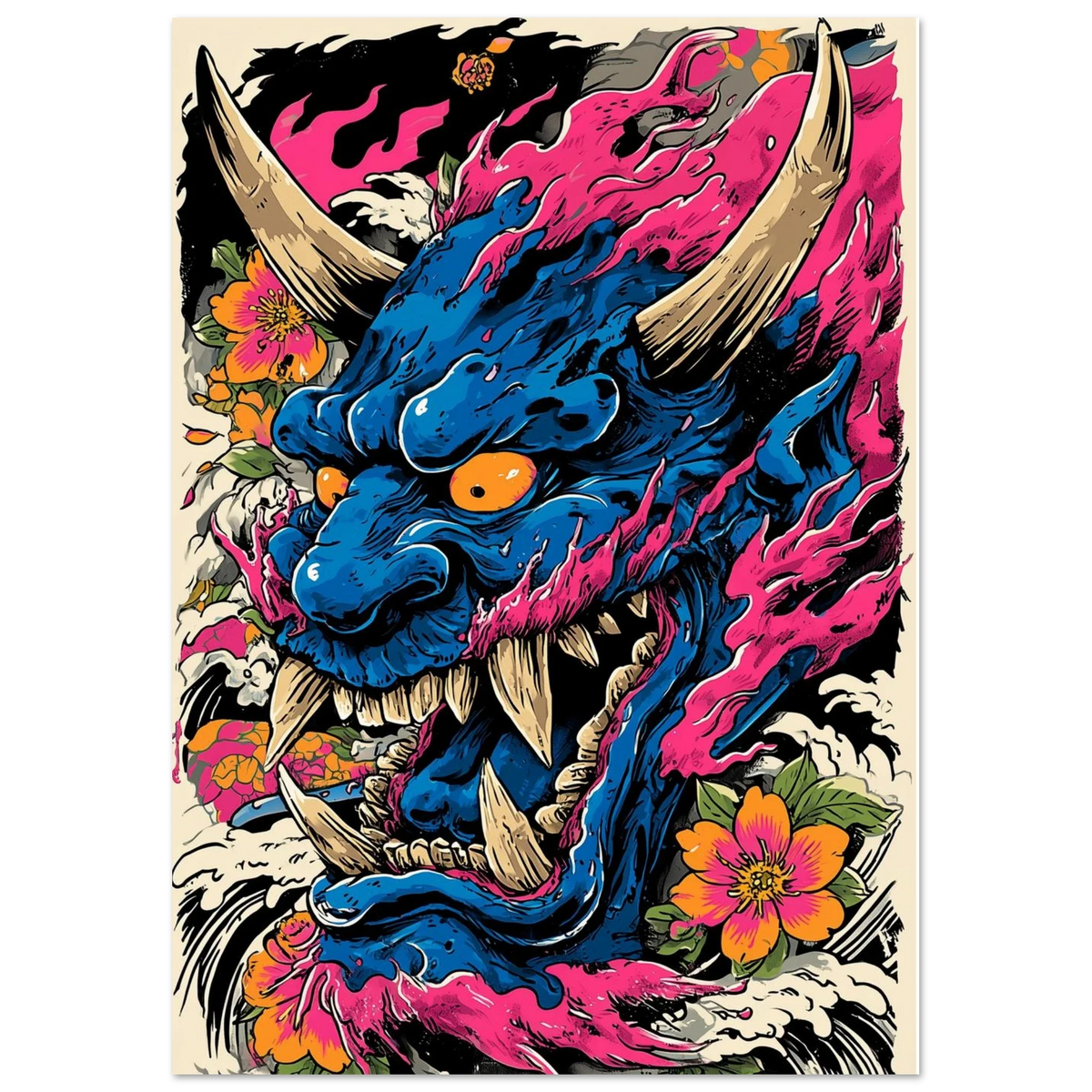
There are a handful of faces in Japanese art that everyone recognises, even people who couldn't name a single yokai. The Hannya is one of them.
Two long horns. Bared teeth. A face that looks like it's smiling and weeping at the same time. It shows up on tattoo arms in Tokyo and Sydney and São Paulo. It's been worn by yakuza and by people who've never been to Japan. It's printed on T-shirts, painted on murals, hung above bars and tattoo parlours.
But almost nobody who wears it knows the actual story. Most of the meaning gets lost in the aesthetic.
This is the long version. Where the mask came from, who she was before, what the three stages of transformation actually mean, and why — once you know — the Hannya stops feeling like a demon and starts feeling like a survivor.
If you're here from the broader guide to Japanese tattoo meanings, this is the deep-dive on the demon most people end up choosing.
What is a Hannya mask?
A Hannya is a traditional Noh theatre mask depicting a female demon — one consumed by jealousy and grief until she stopped being human. The mask has two sharp horns, metallic eyes, bared fangs, and a face frozen in an expression that reads as both rage and sorrow depending on the angle the light hits it.
In Japanese theatre, the mask is used to portray a specific kind of character: a woman wronged by love, transformed by the weight of what she couldn't let go of. In Japanese tattoo art — irezumi — the Hannya has become one of the most heavily worn images in the entire tradition.
It is not, technically, a yokai. The Hannya is a human who became a demon. That distinction matters more than it sounds like it should.
The story behind the mask
The Hannya isn't a single character. She's a pattern that appears across multiple older stories.
The two most famous come from Noh theatre:
Lady Rokujō, from the play Aoi no Ue, was a noblewoman in love with the prince Genji. When he chose another woman over her, Rokujō's jealousy was so consuming that her living spirit — ikiryō — left her body at night and attacked her rival. She didn't choose to become a demon. The grief simply outgrew her.
Kiyohime, from the Dōjōji legend, fell in love with a young monk who promised to return to her and never did. When she finally tracked him down hiding inside a temple bell, her rage transformed her — first into a long, scaled serpent, then into something fully demonic. She wrapped herself around the bell and burned him alive inside it.
Both stories share the same shape: a woman is loved badly, the pain has nowhere to go, and the pain becomes a face.
That face is the Hannya.
The three stages of becoming a Hannya
What makes the Hannya unusual in mythology is that the transformation is gradual. Most monsters in folklore are born monsters, or transformed in a single moment. The Hannya happens in stages, and Noh theatre uses three different masks to represent them:
Namanari (生成) — The early stage. Mostly still a woman. Horns are just starting to appear. She might still pass for human at first glance. The pain is fresh and she hasn't fully accepted what she's becoming.
Chūnari (中成) — The middle stage. More demon than woman now. Horns longer, fangs more visible, skin discolouring. There's no going back from here, but she still remembers being human.
Honnari (本成) — the full Hannya — The final stage. Fully demonic. Horns curved and gold. Eyes metallic, expression locked. The serpent body coiled below the face in some depictions. She is now what her grief made her.
There's also a fourth stage that appears in some traditions: Ja — fully serpent, no face left. This is the rarest, and what Kiyohime is said to have become in the moment she burned the monk alive.
The gradient is the point. The Hannya isn't a creature you wake up as. She's a destination you walk toward in steps small enough that you don't notice you've arrived.
What does the Hannya symbolise?
The most common reading — and the wrong one — is that the Hannya is a warning about women's emotions. "Don't trust a jealous woman." That reading is everywhere, and it's also lazy.
The traditional reading, from Noh scholars and modern Japanese commentators, is closer to this:
The Hannya is what happens when love is treated badly. The mask is grief that ran out of places to go. She isn't the villain of her own story — she's the cost of someone else's cruelty.
When the Hannya appears on stage in Noh, the audience is meant to feel two things at once. Fear, because she's terrifying. And pity, because we know what she used to be.
That double reading is why the Hannya has lasted. She's a demon, but she's a sympathetic demon. The kind of monster you understand.
In modern tattoo culture, people who choose the Hannya are almost never choosing the rage. They're choosing the survival on the other side of it — the part where pain becomes a face you can show, instead of something you have to hide.
The Hannya in irezumi tattoo art
In Japanese tattoo tradition, the Hannya is one of the four or five images you'll see most often across the entire body of work. There's a reason.
Irezumi is, at its heart, an art form about transformation. The body itself becomes the medium. The tattoo takes years. The pain is part of the work. To wear an image of a creature who transformed through pain is to commit to that lineage in your own skin.
The Hannya shows up in a few recurring compositions:
Hannya alone, on a shoulder or back panel. The face does the whole job. Often paired with cherry blossoms (sakura) — the symbol of impermanence, of beauty that ends. The pairing is intentional: a face that won't let go of impermanence is the Hannya in a single image.
Hannya with a snake. This is the Kiyohime composition — the demon and the serpent she becomes. Sometimes the snake winds through her hair or coils below her face. It's the most violent and the most loaded version.
Hannya with peonies (botan). Peonies in Japanese tattoo art symbolise wealth, prosperity, and bravery. The pairing reads as: I have walked through this and come out the other side with my dignity intact.
Hannya with waves and clouds. The face emerging from chaos. Less direct than the snake version, more meditative.
The colours carry meaning too. The traditional Hannya mask comes in different shades depending on the stage and the woman's status in the original story:
- White Hannya — high-born, refined, more grief than rage. Lady Rokujō reads.
- Red Hannya — common-born, deep rage, raw transformation.
- Black Hannya — fully demonic, late stage, no return.
- Gold horns — luxury detail in modern tattoo work; signals expense and care.
If you're choosing a Hannya design — for ink or for the wall — the colour is doing real symbolic work.
How to choose a Hannya
The honest filter is this: which version of the story do you connect to?
If you want the freshly-transformed Hannya — the namanari stage where the human is still visible underneath — choose a piece with softer colours and less aggressive horns. The face still has grief in it more than rage. This reads as: I'm changing, but I haven't lost myself yet.
If you want the full Hannya — gold-horned, fanged, locked in the final form — choose a piece where the demon has fully arrived. The face is harder. The composition is more aggressive. This reads as: I am what I survived.
The Bakemono Co Hannya print sits in the second category — full Hannya, traditional palette, gold horns, surrounded by peony bloom and ink wash. The composition is from the irezumi sleeve tradition: the face that does the talking, the flowers that say I've made peace with it.
Frequently asked questions
What does the Hannya mask actually mean?
The Hannya represents a woman transformed into a demon by grief and jealousy. The traditional meaning isn't a warning about women — it's about what happens when love is treated badly enough that the pain becomes a permanent shape. In Japanese tattoo art, wearing the Hannya is most often a commitment to transformation, survival, and the dignity of having walked through something hard.
Is it offensive to wear a Hannya mask tattoo or display Hannya art?
The Hannya is a deeply traditional Japanese image, so the cultural-respect question is legitimate. The honest answer: it depends on intent. The Hannya isn't a sacred religious image like a shinbutsu deity — it's a theatrical and tattoo-art image with centuries of use, including by non-Japanese artists. What matters is whether you know the story behind it. Wearing a Hannya as costume is shallow. Wearing it as homage, with the story understood, is closer to how the tradition has always worked.
What's the difference between the Hannya and other Japanese demon masks?
The Hannya is specifically female and specifically transformed — she started human and became a demon through grief. Other masks fill different roles. The Oni mask is a hell-demon, usually male, born a demon. The Tengu mask is a mountain spirit with a long red nose, often used in martial arts iconography. The Namahage mask is from the Akita region, worn during festivals to scare children into good behaviour. The Hannya is the only one of these whose story is about becoming, not being.
What's the connection between Hannya and snakes?
This comes from the Kiyohime legend. When Kiyohime was rejected by the monk Anchin, her grief transformed her in stages — first into a serpent, then into a fully demonic form. In tattoo art, the Hannya is sometimes shown with a serpent body coiled beneath the face, or with a snake winding through her hair, to reference the Kiyohime version of the story specifically.
Are Hannya tattoos lucky or unlucky?
Neither, traditionally. The Hannya isn't a luck symbol. It's a transformation symbol — closer to a memento than a charm. People who wear the Hannya aren't asking for fortune. They're acknowledging something they've already been through.
Why does the Hannya have horns?
The horns are the marker of demonic transformation. In Japanese folklore, growing horns is one of the earliest physical signs that a human is becoming an oni or similar creature. On the Hannya, the horns get longer and more curved as the transformation progresses — namanari has short stubs, full Hannya has long curved blades. The gold tips you see on modern Hannya art are a stylistic addition that came later, often borrowed from theatrical mask traditions.
Where can I see Bakemono Co's Hannya print?
Right here: the Hannya print. Premium 200gsm semi-gloss, printed on demand in Australia, A3 through A0. The composition is traditional Edo-period irezumi — full Hannya face, gold horns, surrounded by peony bloom and black ink wash.
Old myths. New skin.
The Hannya has lasted because the pattern she represents hasn't gone anywhere. People still get loved badly. The pain still has to go somewhere.
What the tradition offers isn't an escape from that pattern. It's a way of marking it — putting a face on it, hanging it on the wall or wearing it on the skin, and saying: this happened, and I'm still here.
That's what the Hannya is. Not a warning. Not a curse. A face for grief that ran out of places to go, and then became something you could finally look at.
See the Hannya print → · Read the full guide to Japanese tattoo meanings →