Japanese Tattoo Meanings: Oni, Hannya, Tengu and the Spirits Behind Irezumi
May 19, 2026· Bakemono Co
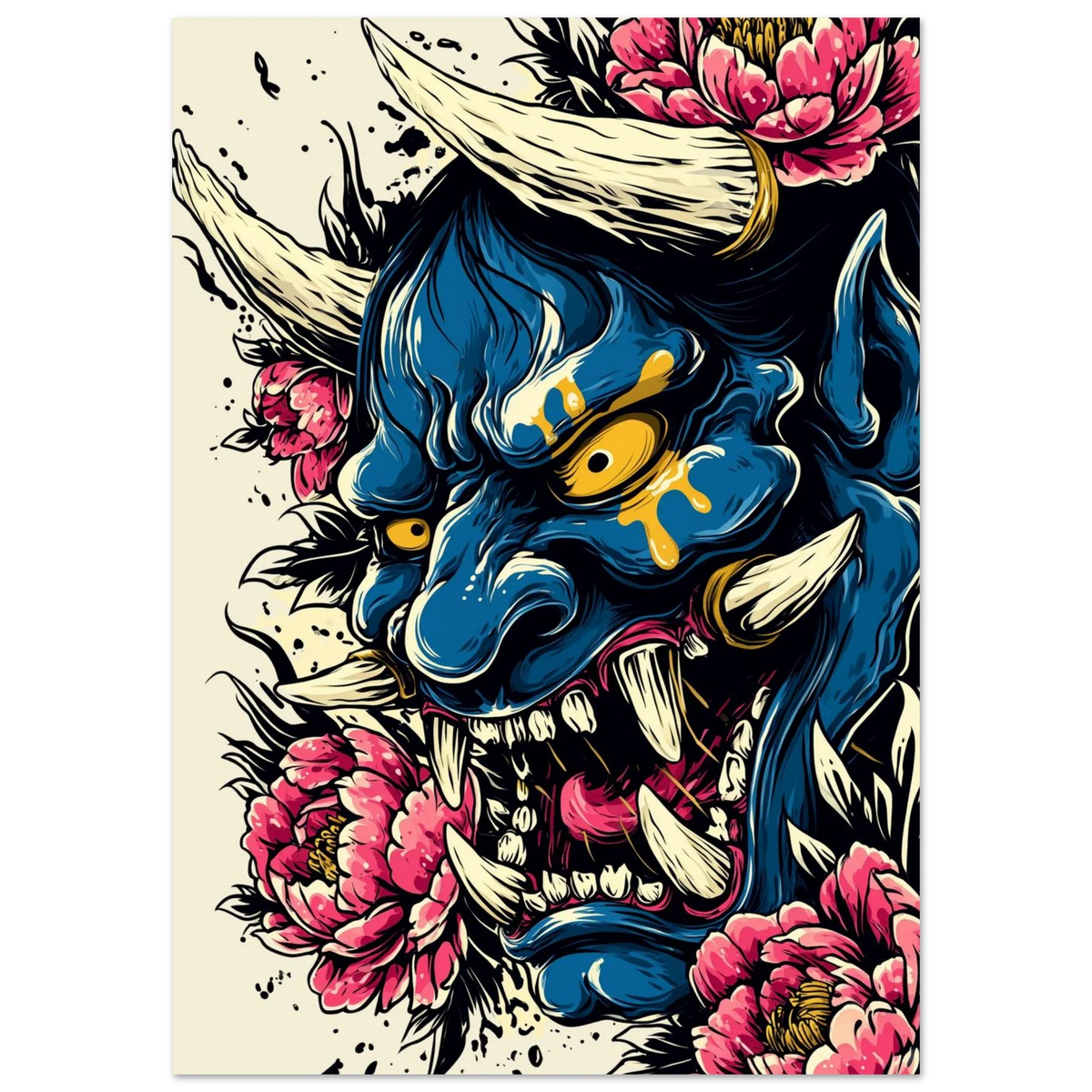
Oni (鬼) and Ao-Oni (青鬼) — the gatekeeper demon and its blue variant
The Oni is the one most people picture first. Horns. Tusks. An iron club called a kanabō. Often red. Sometimes blue, green, or black — the colour matters.
In Buddhist cosmology the Oni started as a hell-warden — the creature that tortured the wicked in the lower realms. In Japanese folklore that role expanded. The Oni became a guardian as often as a torturer. Temples carved them onto roof tiles to scare away worse things. The festival of Setsubun still has families throwing roasted beans at someone wearing an Oni mask, shouting "oni wa soto, fuku wa uchi" — demons out, fortune in.
In tattoo culture the Oni isn't evil. The Oni is whatever you can't get past — the obstacle, the fear, the version of yourself that won. Wearing the Oni is wearing the thing you've decided you can survive.
The colour of an Oni shifts its meaning. Red is raw greed and lust. Green is impatience. Black is doubt. Blue — Ao-Oni — carries the weight of grief, jealousy, and moral failing. The Ao-Oni is the demon that used to be human and remembers it. In some old folk tales the Ao-Oni is gentler than its red counterpart — lonely, looking for a friend, knowing it's been cast out. In others it's the male counterpart to the Hannya: rage transformed, but with the memory of who it was before.
The blue is what makes this one specific. It's not just a demon. It's the demon that grieves.
→ The Ao-Oni print — blue demon with peony and wave, Edo-period tattoo composition.
Hannya (般若) — the mask of jealousy
The Hannya is one of the most recognisable masks in all of Japanese theatre. Two horns. Fangs. A face caught somewhere between fury and weeping.
The story behind it is older than the mask. In Noh theatre, the Hannya is what a woman becomes when grief and jealousy consume her so completely that she stops being human. The transformation is gradual — first a namanari (still mostly woman, just horns), then chūnari (more demon than woman), then the full Hannya: lost.
But the Hannya isn't a warning against women. The traditional reading is more uncomfortable than that. The Hannya is what happens when love is treated badly. The mask is grief that ran out of places to go.
In tattoo art the Hannya is one of the most heavily worn images in irezumi. People who choose it usually aren't choosing the rage. They're choosing the survival on the other side of it — the part where pain becomes a face you can show.
→ The Hannya print — Noh-mask composition, gold horns, traditional palette.
Tengu (天狗) — the mountain spirit
The Tengu lives in two forms. The older form is karasu-tengu — half-man, half-crow, beak and wings and feathers. The later form is yamabushi-tengu — a long-nosed, red-faced warrior monk who lives in the high mountains and trains in martial arts.
Both are tricksters. Both are dangerous. Both are also, occasionally, teachers — the legendary swordsman Minamoto no Yoshitsune was said to have been trained by Tengu in the mountains of Kyoto. The lesson is that mastery comes from somewhere strange, and the things that teach you might bite.
The Tengu's meaning in tattoo art is sharper than most. It's a warning about pride — tengu ni naru literally means to become a Tengu, an idiom for getting full of yourself. But it's also a symbol of mastery, of solitude, of skill earned outside the system.
People who wear the Tengu often have done something the hard way, alone.
→ The Tengu print — long-nosed yamabushi form, traditional irezumi linework.
Seiryu (青龍) — the azure dragon of the east
Japanese dragons are not Western dragons. They don't hoard. They don't burn villages. They live in rivers and storm clouds and bring the rain when the crops need it.
The Seiryu is the most famous of them — the Azure Dragon of the East, one of the four guardian beasts of the cardinal directions. Spring belongs to him. So does wood, water, and the rising sun. In old Kyoto, the eastern half of the city was said to be under his protection — temples on that side were oriented toward him.
In tattoo art the dragon usually wraps around the body in long sweeping curves, often paired with waves, clouds, or wisteria. The meaning is the same wherever it appears: wisdom, power that doesn't need to prove itself, transformation across long timescales. The dragon doesn't rush. The dragon outlasts.
People who choose the Seiryu are often choosing the long view.
→ The Seiryu print — azure dragon coiling through waves, full sleeve-style composition.
Tora (虎) — the tiger of the west
The Tora is the Seiryu's counterpart — the White Tiger of the West, the other half of the four-beast system. Where the dragon is fluid, the tiger is solid. Where the dragon is patient, the tiger is now.
Tigers don't live in Japan. They never did. But Japanese artists drew them constantly anyway — copied from Chinese paintings, sketched from imported pelts, imagined from descriptions. The result is a tiger that doesn't quite behave like a real one. The Japanese tiger pounces, snarls, has eyes too large for its head. It's the idea of a tiger more than the biology.
In tattoo culture the tiger is straight protection — against bad luck, sickness, and demons (yes, including the other things on this list). It's the warrior energy. Courage without doubt. The strike that doesn't second-guess itself.
→ The Tora print — striped roar, bamboo backdrop, classic compositional balance.
Okami (狼) — the wolf and the great spirit
The Okami is a double word. Written one way (狼) it's wolf. Written another (大神) it's great spirit or god. Old Japanese leaned into the overlap — mountain wolves were treated as messengers of the kami, the spirits of place. Farmers left offerings for them. Shrines were dedicated to them. They weren't predators in the folklore. They were guardians.
Then they were killed off. The Honshu wolf went extinct in 1905, hunted out under a rabies panic and a Meiji-era push to modernise. The Hokkaido wolf followed it. The animal that had been worshipped for centuries vanished in a generation.
That tragedy now sits underneath the symbol. To wear the Okami in tattoo art today is to wear something with a ghost in it — loyalty, pack, protection, but also loss. The thing that should still be here.
→ The Okami print — wolf in motion, ink-wash style, moonlit composition.
Dokuro and Hebi (髑髏と蛇) — the skull and the snake
Dokuro is the skull. Hebi is the snake. Put together they're one of the oldest pairings in irezumi.
The skull on its own is a memento mori — a reminder that the body ends. In Japanese tattoo tradition the dokuro isn't morbid. It's matter-of-fact. The skull is the part of you that doesn't lie. Strip everything else and that's what's underneath.
The snake adds the other half of the conversation. Snakes shed their skin and walk away. They're the symbol of change you survive — the thing that comes out the other side of an ending and keeps moving. In Japanese folklore the snake also has wisdom: long memory, patience, knowing when to strike and when to wait.
Together, the dokuro-hebi pairing says: everything ends, and then something else begins. The skull is what's permanent. The snake is what changes form on top of it.
That's the whole brand, really.
→ The Dokuro-Hebi print — skull through serpent coils, bone-and-ink palette.
How to choose which one is yours
There's no right one. There's no "starter" demon. People who try to rank these the way you'd rank Pokémon are missing the point.
A few honest filters:
If you've been through something and come out different, the Hannya and the Dokuro-Hebi are the survival pieces. Hannya for transformation through pain. Dokuro-Hebi for endings you walked away from.
If you want protection, the Tora and the Ao-Oni do that work — Tora for active warding, Ao-Oni for keeping the worse things out by being something worse yourself.
If you've earned a thing the hard way, the Tengu and the Okami fit. Tengu for mastery learned alone. Okami for loyalty to a small pack against a bigger world.
If you take the long view, the Seiryu is the dragon for that. Patience. Wisdom that doesn't have to be loud.
If you don't know yet, the Ao-Oni is usually the right starting place. Everyone has something they can't get past, and the blue Oni — the demon that remembers being human — is the most honest mirror for that.
Frequently asked questions
What's the difference between yokai, bakemono, and oni?
Yokai (妖怪) is the umbrella term — all the supernatural creatures in Japanese folklore, friendly and hostile alike. Bakemono (化け物) is a subset: yokai that shape-shift. Oni (鬼) is a specific kind of demon. So an Oni is a yokai, and sometimes a bakemono if it can change form. Bakemono Co is named after the shape-shifting category because every print takes an old myth and gives it a new form.
Is it disrespectful to display Japanese tattoo art if I'm not Japanese?
This is a fair question and the honest answer depends on intent. Irezumi has a long, complicated history in Japan — including periods of legal ban and association with organised crime that still affects public attitudes today. Many traditional Japanese tattoo artists welcome respectful outsiders. Others don't. Displaying art at home is a less loaded version of the same question than putting it on your body, but the underlying principle is the same: come at it as homage, not as costume. Learn what you're putting on the wall. That's most of the work.
What's the difference between Oni and Hannya?
Both are demons but the origins are very different. Oni is usually male, externally born — a creature from Buddhist hell, or simply a being that was always a demon. Hannya is specifically female and transforms into a demon from a human starting point, driven by grief and jealousy. Oni is external force. Hannya is internal change.
Why do Japanese dragons look different from Western dragons?
Eastern dragons (like Seiryu) are benevolent — bringers of rain, controllers of water, long-lived sources of wisdom. Western dragons are mostly hostile — fire-breathers, hoarders, the things that knights kill. Same word in English, completely different mythological role. The Japanese dragon is closer to a river spirit than a monster.
What does the colour of an Oni mean?
In traditional symbolism: red Oni for raw greed and lust, blue Oni for jealousy and moral failing, green for impatience, black for doubt, yellow for indecision. Modern artists treat these loosely — colour is often just an aesthetic choice now. But the original meanings sit underneath the design language and shape what feels "right" for each one.
Where can I see Bakemono Co's prints?
All of the designs covered in this post are available at bakemono.co — premium 200gsm semi-gloss art prints, printed on demand in Australia, sized A3 through A0 (the largest is 84 × 119 cm — bigger than most people picture). The whole catalogue is here: the collection.
Old myths. New skin.
Every creature in this guide started as somebody else's story, told around a fire or carved into a temple beam or whispered to a tattoo apprentice. They've been changing form ever since.
Bakemono Co is one more version. The old myths are still doing what they always did — naming the thing you can't get past so you can hang it on the wall and look at it.